
The narrowband filter is subdivided from the band-pass filter, and its definition is the same as that of the band-pass filter, that is, this filter allows optical signals to pass in a specific band, and optical signals on both sides deviated from this band are blocked. The passband of the narrow-band filter is relatively narrow, generally less than 5% of the central wavelength value
What is Narrowband Filters? Translated into vernacular, it is an optical lens that only allows the required light to pass through, and a narrow-band filter selectively passes through the light of a certain band. At present, narrowband filters are widely used in different sensors for simultaneous interpreting and synthesizing optical signals. A narrowband interference filter is characterized by a narrow passband and deep cut-off depth of the cut-off band.
Based on the development of laser application, the narrow-band filter uses a magnetron sputtering coating process. Considering the need to have a high laser damage threshold, the hard film process must be used. The average transmission of this product of our company is more than 90%, the bandwidth is only 8nm, and the cut-off depth is od5. It perfectly combines the transmission and cut-off performance in both excitation and fluorescence applications, without stray light, The imaging contrast is clear.
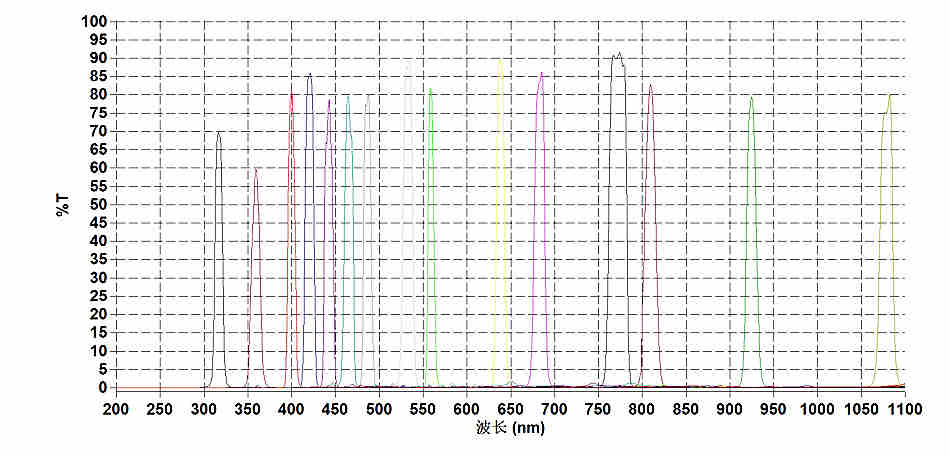
The main parameters are:
Central wavelength
FWHM (bandwidth)
Peak transmittance
Cut off range
Cut off depth (OD value)
Central wavelength: the central wavelength of the narrow-band filter is generally the working wavelength of the instrument or equipment, which refers to the wavelength at the center of the passband.
Half-width (bandwidth): bandwidth refers to the distance between two positions in the passband where the transmittance is half of the peak transmittance. Sometimes it is also called half-width (not called half bandwidth). The English letter is often expressed by FWHM (full width at half maximum).
Peak transmittance: refers to the highest transmittance of the bandpass filter in the passband.
Cut-off range: the cut-off range refers to the wavelength range required to be cut off except the passband. For narrow-band filters, there is a front cut-off, that is, the cut-off wavelength is less than the central wavelength, and there is a long cut-off, and the cut-off wavelength is higher than the central wavelength.
Cut off depth (OD value): the cut-off depth refers to the maximum transmittance allowed to transmit light in the cut-off band. Different application systems have different requirements for cut-off depth. For example, in the case of excitation light fluorescence, the cut-off depth is generally required to be less than T < 0.001%. In the ordinary monitoring and identification system, the cut-off depth of T < 0.5% is sometimes enough. For simplicity, the OD value is often used to represent the cut-off depth. OD=-lgT
Applications: machine vision, biochemical analysis, optical instruments, spectral measurement and other fields.
What is Narrowband Filters? Translated into vernacular, it is an optical lens that only allows the required light to pass through, and a narrow-band filter selectively passes through the light of a certain band. At present, narrowband filters are widely used in different sensors for simultaneous interpreting and synthesizing optical signals. A narrowband interference filter is characterized by a narrow passband and deep cut-off depth of the cut-off band.
Based on the development of laser application, the narrow-band filter uses a magnetron sputtering coating process. Considering the need to have a high laser damage threshold, the hard film process must be used. The average transmission of this product of our company is more than 90%, the bandwidth is only 8nm, and the cut-off depth is od5. It perfectly combines the transmission and cut-off performance in both excitation and fluorescence applications, without stray light, The imaging contrast is clear.
The main parameters are:
Central wavelength
FWHM (bandwidth)
Peak transmittance
Cut off range
Cut off depth (OD value)
Central wavelength: the central wavelength of the narrow-band filter is generally the working wavelength of the instrument or equipment, which refers to the wavelength at the center of the passband.
Half-width (bandwidth): bandwidth refers to the distance between two positions in the passband where the transmittance is half of the peak transmittance. Sometimes it is also called half-width (not called half bandwidth). The English letter is often expressed by FWHM (full width at half maximum).
Peak transmittance: refers to the highest transmittance of the bandpass filter in the passband.
Cut-off range: the cut-off range refers to the wavelength range required to be cut off except the passband. For narrow-band filters, there is a front cut-off, that is, the cut-off wavelength is less than the central wavelength, and there is a long cut-off, and the cut-off wavelength is higher than the central wavelength.
Cut off depth (OD value): the cut-off depth refers to the maximum transmittance allowed to transmit light in the cut-off band. Different application systems have different requirements for cut-off depth. For example, in the case of excitation light fluorescence, the cut-off depth is generally required to be less than T < 0.001%. In the ordinary monitoring and identification system, the cut-off depth of T < 0.5% is sometimes enough. For simplicity, the OD value is often used to represent the cut-off depth. OD=-lgT
Applications: machine vision, biochemical analysis, optical instruments, spectral measurement and other fields.
Narrowband Filters