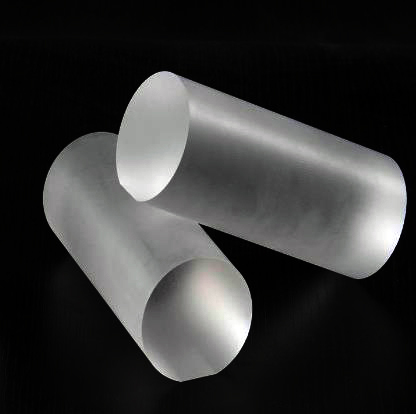
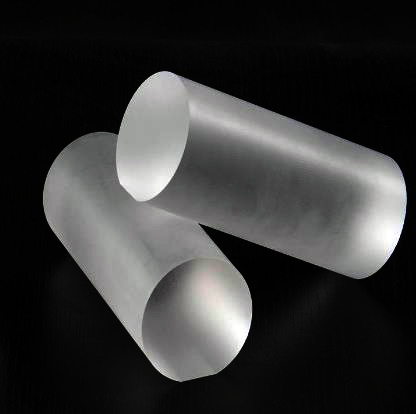
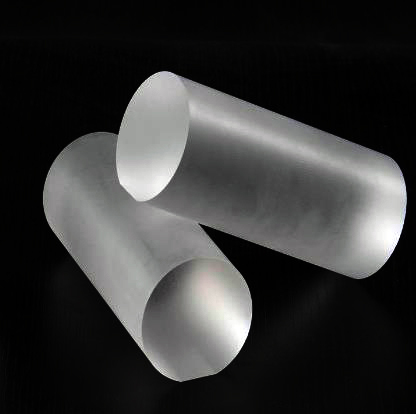
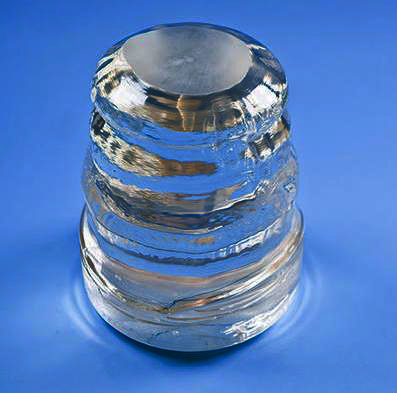
Sapphire ingot is an alumina crystal used to produce sapphire substrate. The application of sapphire ingot is the application of sapphire. As long as we understand the performance of sapphire, we can understand the application of sapphire ingot. Sapphire has a hexagonal lattice structure, and many properties are determined by its crystal orientation.
Through the growth of epitaxial films, different crystal orientations will show different lattice matching. Sapphire has certain birefringence, and special crystal axes are used in some optical fields. For example, polarization substrate: C-section sapphire substrate is used to grow III-V and II-VI deposited films, such as gallium nitride, which can produce blue LED products, laser diodes, and infrared detector applications. A-type substrate produces uniform dielectric constant/dielectric and high insulation for Hybrid Microelectronics. High-temperature superconductors can be produced by long crystals on a type of substrate. Externally elongated crystals of different deposited silicon grown on R-type substrates have been used in microelectronic integrated circuits. Because of its high capacitance, sapphire is the best choice for hybrid substrates, such as in microwave integrated circuits. In addition, high-speed integrated circuits and pressure sensors can be formed in the manufacturing process of epitaxial silicon films. R-type substrate growth can also be used to manufacture mounds, other superconducting components, high resistance resistors, and gallium arsenide. Both A-type and R-type can grow nonpolar or semi-polar Gan.
As a commercial product, sapphire still needs a lot of research to improve the quality of Gan epitaxial materials. Purity: sapphire is an insulating material, and its semiconductor properties will be changed due to doping and impurities. Therefore, most purity control is not due to strict control of substrate materials (silicon, gallium arsenide, indium phosphide...). However, some trace dopants change their optical properties (color, photoconductivity range), which is very important for applications in some fields (optical and military), because the purity of sapphire has a great impact on the electrical properties of CMOS and cross-contamination of a metal surface (complementary metal-oxide-semiconductor), and its application in SOS (silicon technology on sapphire) It is also very important in the application of. Has been a professional manufacturer of high-quality sapphire chips and optical windows. We provide optical sapphire, sapphire rods, and sapphire components. For more information, please contact us.
Through the growth of epitaxial films, different crystal orientations will show different lattice matching. Sapphire has certain birefringence, and special crystal axes are used in some optical fields. For example, polarization substrate: C-section sapphire substrate is used to grow III-V and II-VI deposited films, such as gallium nitride, which can produce blue LED products, laser diodes, and infrared detector applications. A-type substrate produces uniform dielectric constant/dielectric and high insulation for Hybrid Microelectronics. High-temperature superconductors can be produced by long crystals on a type of substrate. Externally elongated crystals of different deposited silicon grown on R-type substrates have been used in microelectronic integrated circuits. Because of its high capacitance, sapphire is the best choice for hybrid substrates, such as in microwave integrated circuits. In addition, high-speed integrated circuits and pressure sensors can be formed in the manufacturing process of epitaxial silicon films. R-type substrate growth can also be used to manufacture mounds, other superconducting components, high resistance resistors, and gallium arsenide. Both A-type and R-type can grow nonpolar or semi-polar Gan.
As a commercial product, sapphire still needs a lot of research to improve the quality of Gan epitaxial materials. Purity: sapphire is an insulating material, and its semiconductor properties will be changed due to doping and impurities. Therefore, most purity control is not due to strict control of substrate materials (silicon, gallium arsenide, indium phosphide...). However, some trace dopants change their optical properties (color, photoconductivity range), which is very important for applications in some fields (optical and military), because the purity of sapphire has a great impact on the electrical properties of CMOS and cross-contamination of a metal surface (complementary metal-oxide-semiconductor), and its application in SOS (silicon technology on sapphire) It is also very important in the application of. Has been a professional manufacturer of high-quality sapphire chips and optical windows. We provide optical sapphire, sapphire rods, and sapphire components. For more information, please contact us.
Sapphire Ingot